
Understanding Taps and Dies
Whether you’re repairing damaged threads or creating new ones, a tap and die set is one of the most valuable tools in any workshop. These tools allow engineers, mechanics, fabricators, maintenance technicians, and DIY enthusiasts to create accurate threads that ensure bolts, nuts, and fasteners fit securely.
Although many people have heard of taps and dies, they are often unsure of the difference between them or when each one should be used. Understanding how these tools work can help you complete repairs correctly, extend the life of components, and avoid costly replacements.
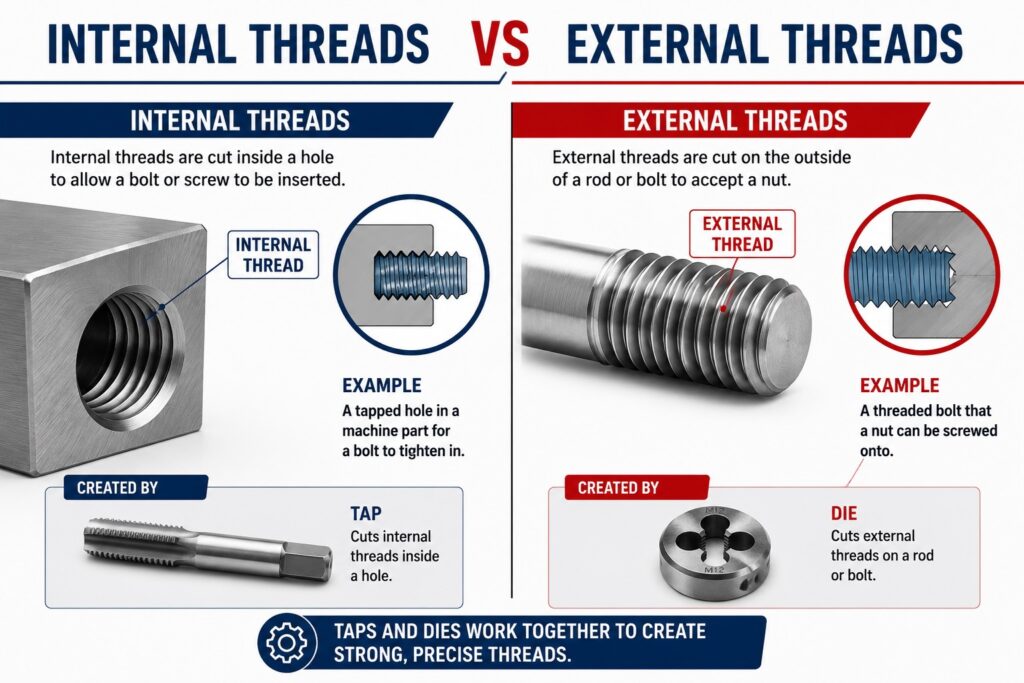
A tap is used to cut internal threads inside a drilled hole, allowing bolts or screws to be fastened securely. A die, on the other hand, cuts external threads onto rods, bolts, or shafts, making them ready to accept nuts or threaded fittings. Together, they form a complete threading solution for manufacturing, maintenance, and repair work.
Tap and die sets are widely used in automotive workshops, engineering companies, fabrication shops, mining operations, industrial maintenance, and general mechanical repairs. They are equally useful for restoring damaged threads or producing new threaded components when replacement parts are unavailable.
What Is a Tap?
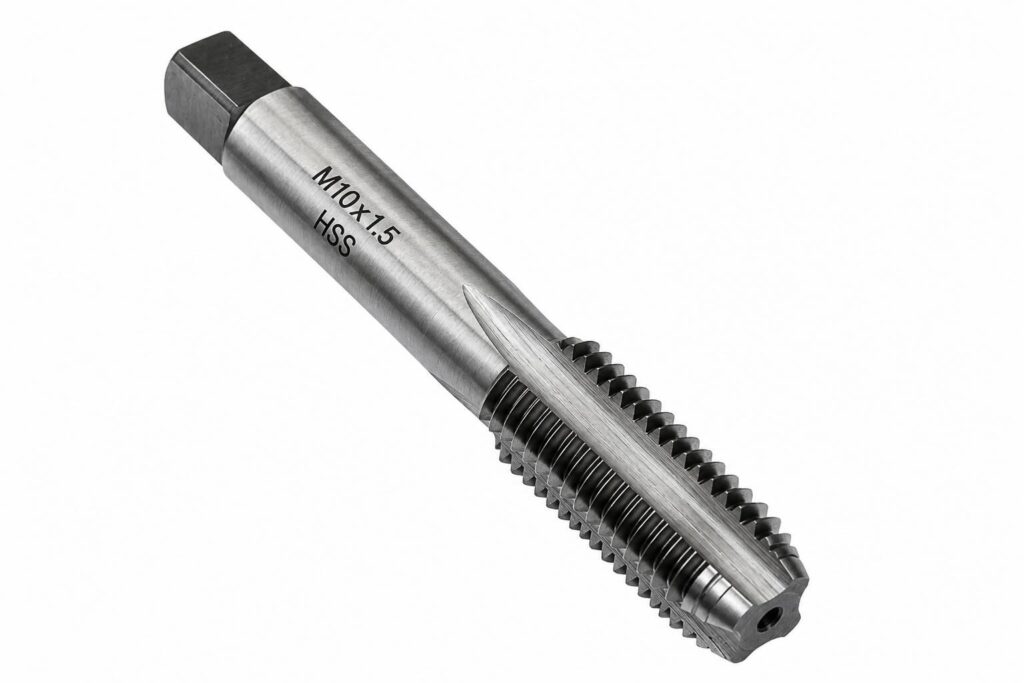
A tap is a cutting tool used to create internal threads inside a drilled hole. These threads allow a bolt or machine screw to be securely fastened into a component. Taps are commonly used when manufacturing new parts or repairing damaged threaded holes.
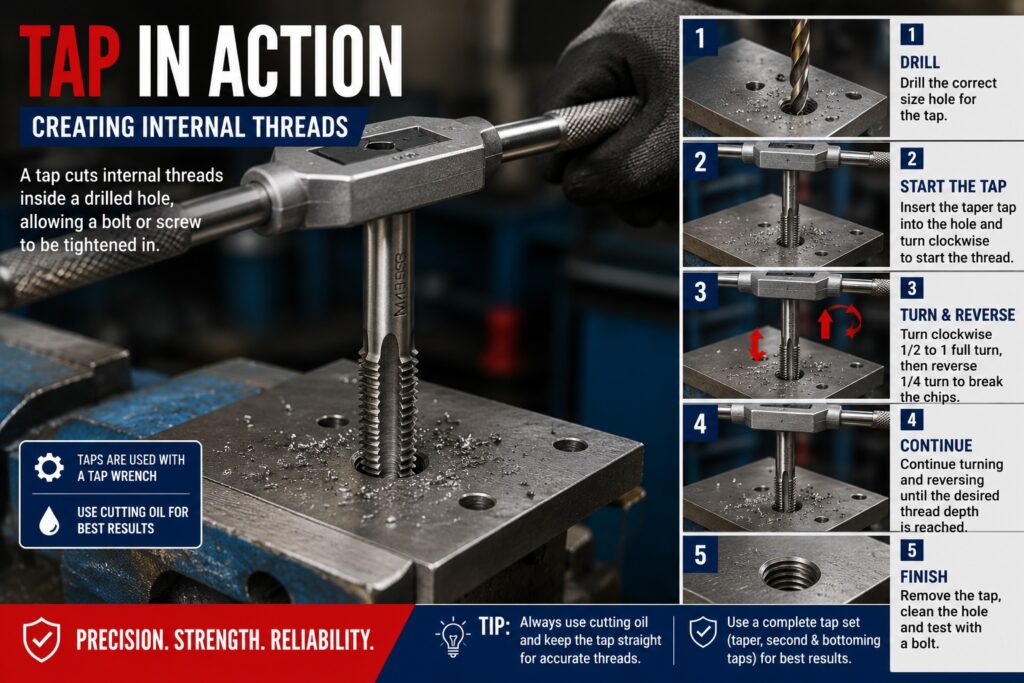
To use a tap, the correct size hole is first drilled into the material. The tap is then inserted into the hole using a tap wrench and rotated slowly while applying cutting lubricant. As it turns, the cutting edges remove small amounts of material to produce clean, accurate threads.
Taps are widely used in steel, aluminium, cast iron, brass, and other metals. They are essential tools in engineering workshops, automotive repairs, machine maintenance, and fabrication industries where precision threading is required.
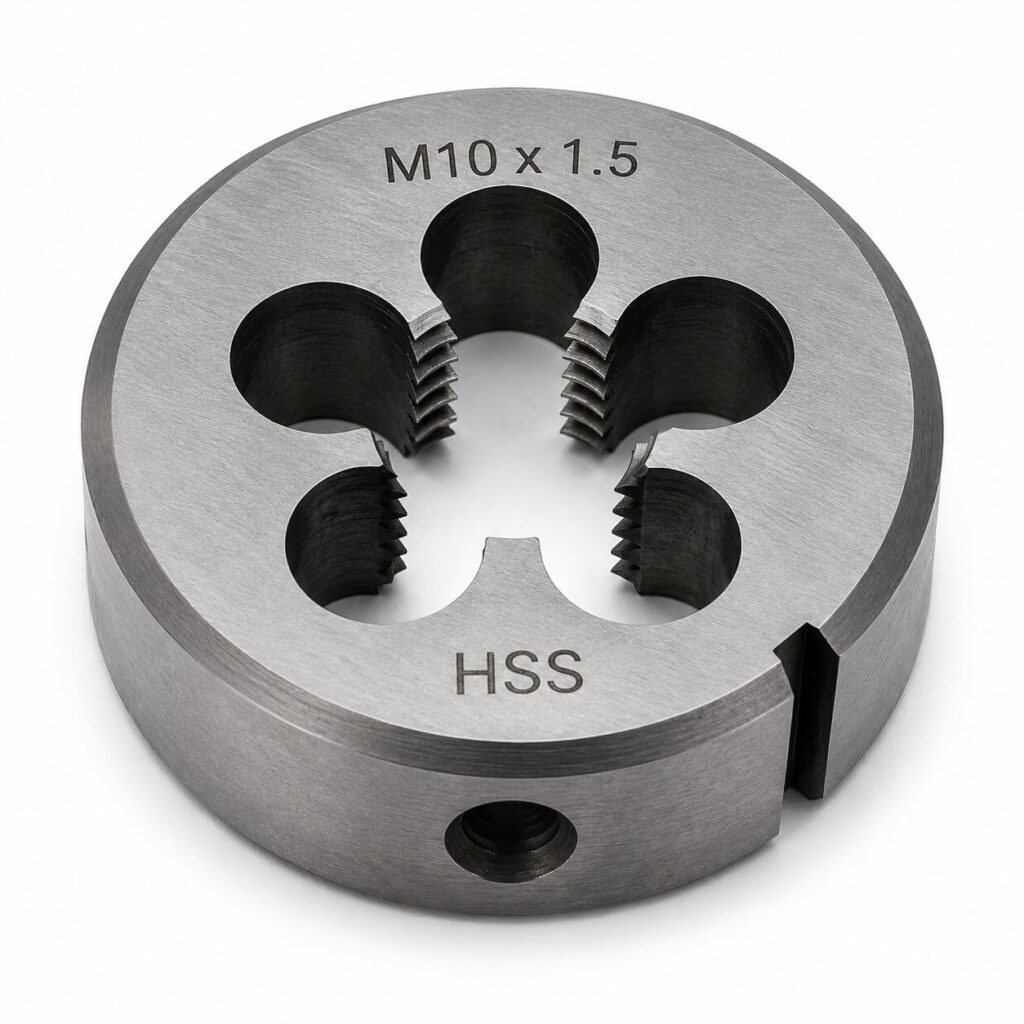
A die is a cutting tool designed to create or restore external threads on rods, bolts, shafts, or other cylindrical metal components. These threads allow nuts, fittings, or couplings to be fitted securely.
Unlike a tap, which cuts threads inside a hole, a die cuts threads around the outside of a workpiece. Dies are normally used with a die stock or die holder, which keeps the die aligned while it is turned onto the material.
Dies are commonly used to manufacture threaded rods, repair damaged bolts, shorten threaded rods, or restore worn threads without replacing the entire component.
What Is a Die?
What Is a Tap & Die Set?
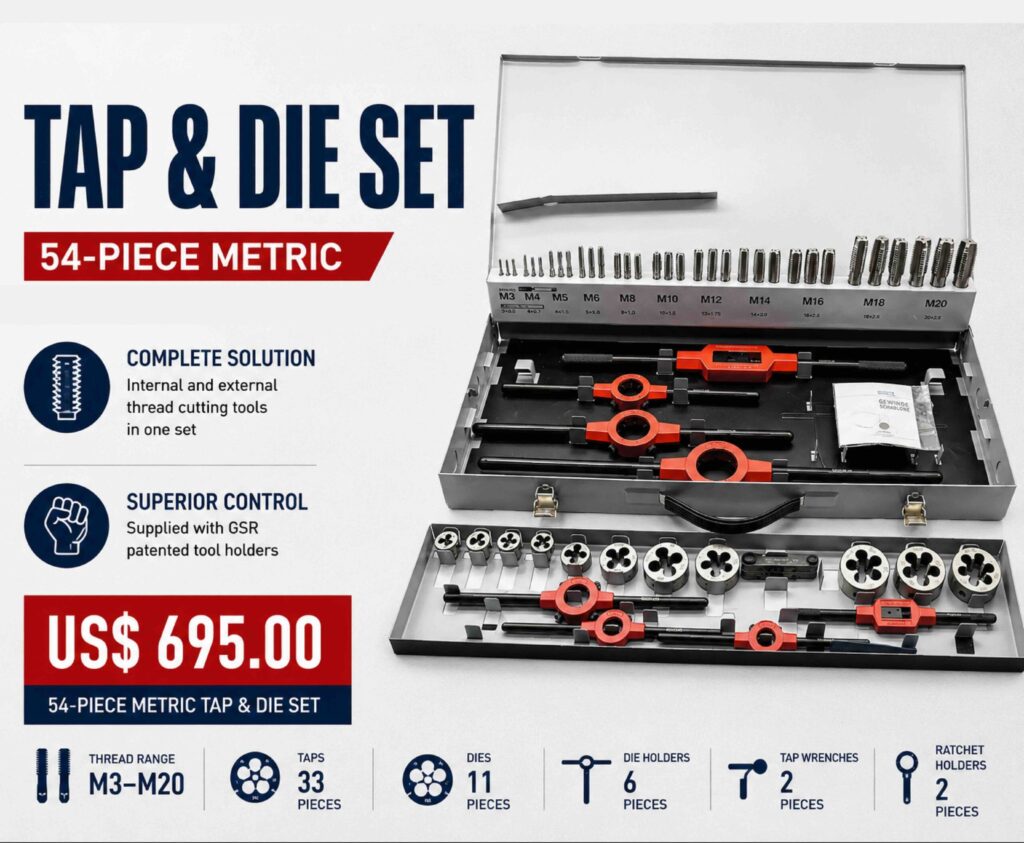
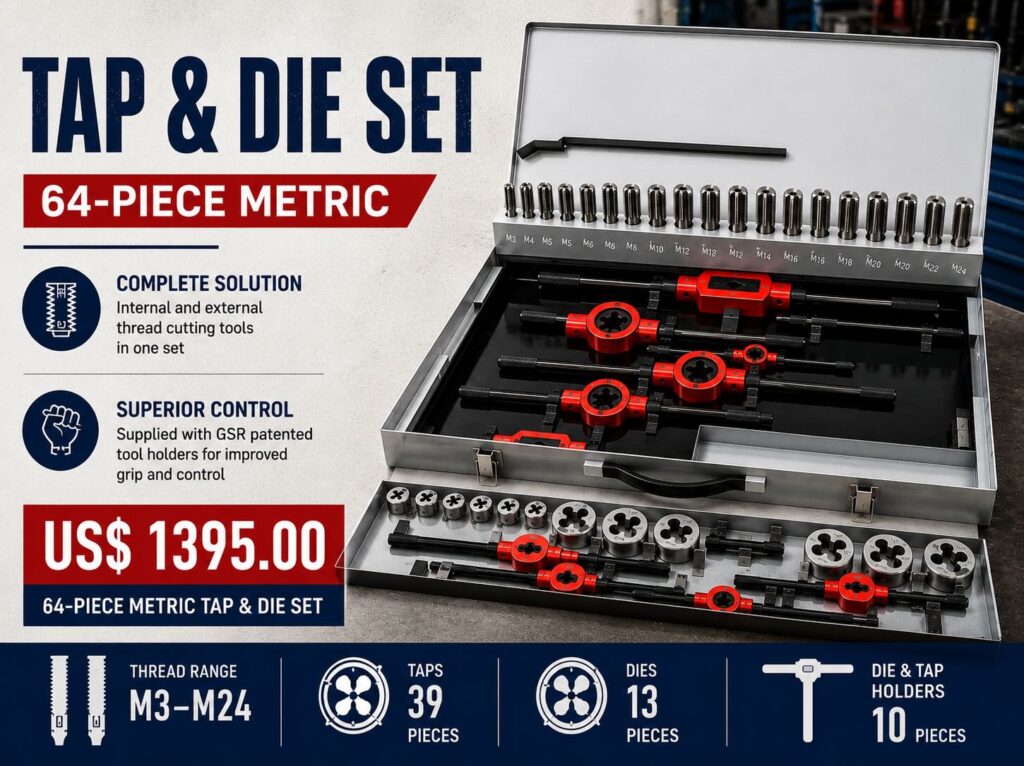
A tap and die set combines all the tools needed to create and repair both internal and external threads. Instead of purchasing individual tools, a complete set provides a range of tap sizes, dies, holders, wrenches, and accessories neatly organised in a durable storage case.
A quality metric tap and die set typically includes multiple taps, matching dies, tap wrenches, die holders, thread gauges, screwdrivers, and other accessories for accurate thread cutting across various sizes.
Professional-grade sets, such as the ACE CRAFT 54-Piece and 64-Piece Metric Tap & Die Sets, are manufactured from HSS M2 (High-Speed Steel) to provide excellent wear resistance, durability, and long service life. These sets are suitable for workshops, maintenance teams, engineering companies, and industrial repair applications.
Common Applications of Tap & Die Sets
Tap and die sets are used across many industries where threaded fasteners are required. Their versatility makes them an essential addition to any professional workshop.
Common applications include:
- Repairing stripped or damaged threads
- Manufacturing new threaded holes
- Producing threaded rods and studs
- Automotive engine and gearbox repairs
- Heavy equipment maintenance
- Engineering and fabrication workshops
- Mining equipment servicing
- Agricultural machinery repairs
- General industrial maintenance
- Home workshop and DIY projects
Having a quality tap and die set available allows technicians to complete repairs quickly while avoiding unnecessary replacement of expensive components.
Understanding the Three Types of Taps
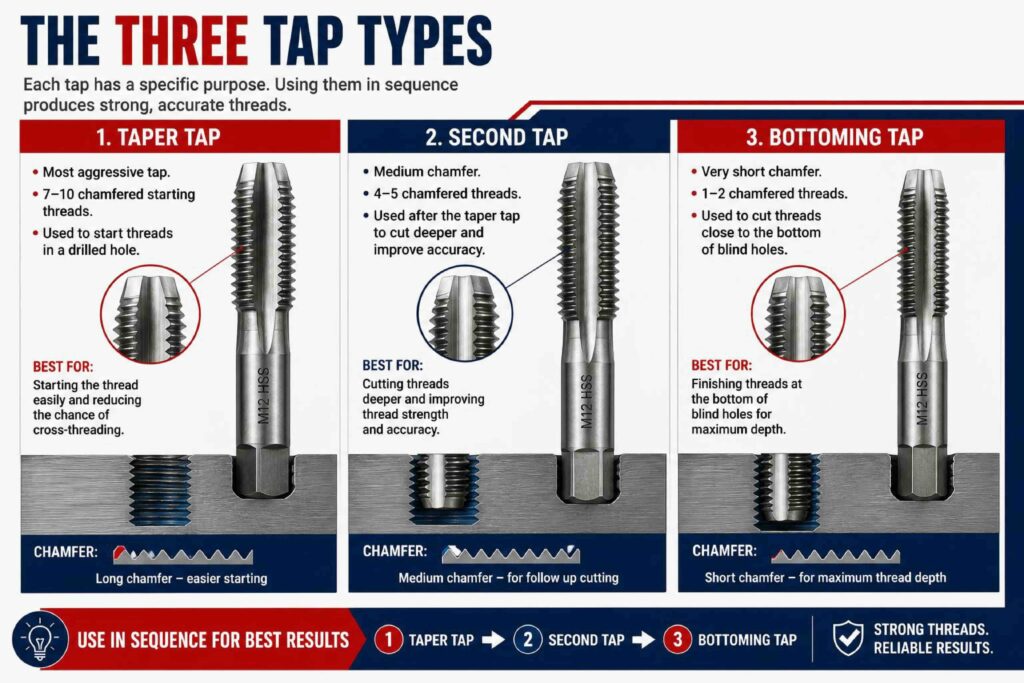
Most professional tap and die sets include three different taps for each thread size. Each tap performs a specific role during the threading process, producing stronger and more accurate threads.
Taper Tap
The taper tap has a long chamfer that gradually introduces the cutting edges into the hole. This makes it the easiest tap to start and reduces the risk of cross-threading. It is always used first when creating a new thread.
Second Tap
The second tap continues cutting after the taper tap has established the initial thread. It removes additional material and improves thread depth and accuracy.
Bottoming Tap
The bottoming tap has only a short chamfer and is designed to cut threads almost to the bottom of blind holes. It is used after the taper and second taps have already created the initial thread.
Using the three taps in sequence produces stronger, cleaner, and more accurate threads.
How to Use a Tap
Correct tapping technique improves thread quality and extends tool life.
- Drill the correct size hole.
- Secure the workpiece firmly.
- Apply suitable cutting oil.
- Insert the taper tap squarely into the hole.
- Turn the tap clockwise slowly.
- Reverse approximately one-quarter turn every half turn to break metal chips.
- Continue until the required depth is reached.
- Remove the tap and clean the finished thread.
Taking your time and keeping the tap aligned helps prevent broken taps and damaged threads.
How to Use a Die
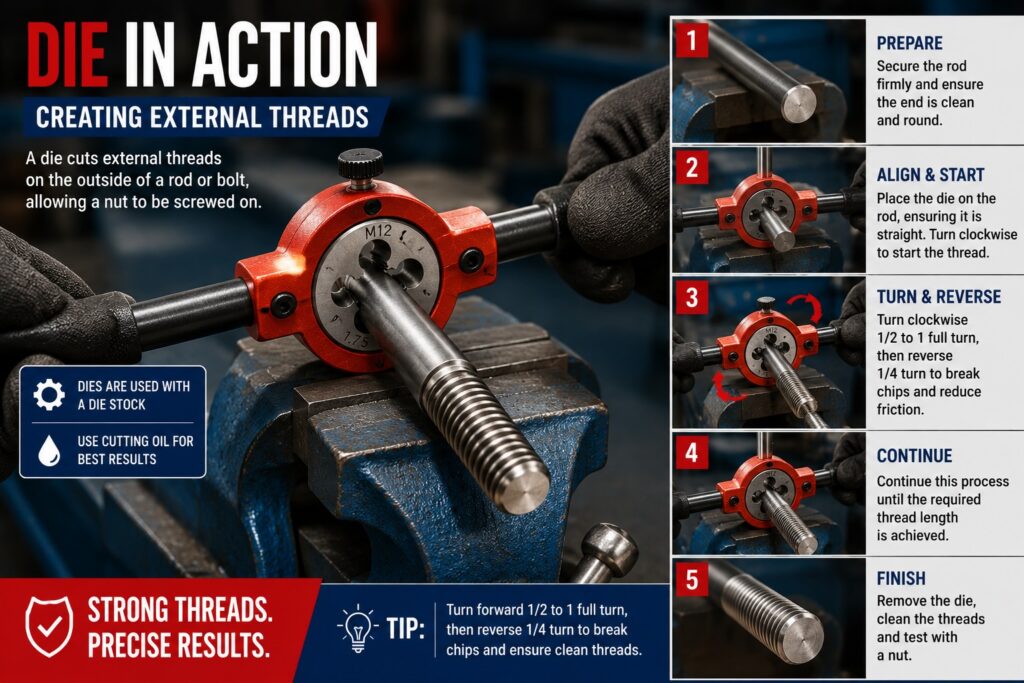
Using a die correctly produces clean, accurate external threads.
- Secure the rod firmly in a vice.
- Chamfer the end of the rod slightly.
- Apply cutting lubricant.
- Insert the die into the die holder.
- Align the die squarely with the rod.
- Turn clockwise while applying even pressure.
- Reverse periodically to clear chips.
- Continue until the desired thread length has been produced.
Always inspect the finished threads before fitting nuts or threaded components.
Common Mistakes to Avoid
Even experienced users can damage taps, dies, or workpieces by using incorrect techniques.
Avoid these common mistakes:
- Using the wrong drill size
- Cutting without lubricant
- Applying excessive force
- Starting the tap or die at an angle
- Failing to reverse periodically to break chips
- Using worn or damaged cutting tools
- Cutting threads too quickly
Following proper procedures produces cleaner threads and significantly increases tool life.
How to Choose the Right Tap & Die Set
Selecting the correct tap and die set depends on the work you perform regularly.
When comparing sets, consider:
Correct tapping technique improves thread quality and extends tool life.
- Drill the correct size hole.
- Secure the workpiece firmly.
- Apply suitable cutting oil.
- Insert the taper tap squarely into the hole.
- Turn the tap clockwise slowly.
- Reverse approximately one-quarter turn every half turn to break metal chips.
- Continue until the required depth is reached.
- Remove the tap and clean the finished thread.
Taking your time and keeping the tap aligned helps prevent broken taps and damaged threads.
Understanding Thread Pitch and Threads Per Inch (TPI)
When selecting a tap or die, it’s important to understand the difference between thread pitch and Threads Per Inch (TPI). These measurements determine how the threads are spaced and ensure that bolts, nuts, and threaded holes fit together correctly.
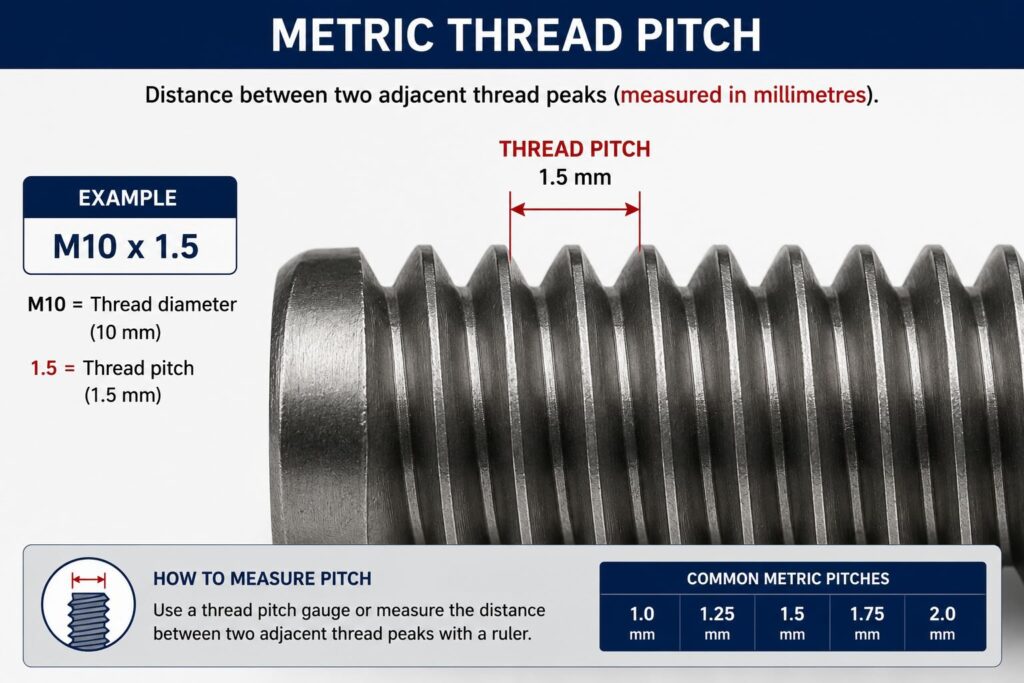
What Is Thread Pitch?
Thread pitch is the distance between one thread and the next, measured in millimetres (mm). It is used on metric fasteners. For Example
Thread Size | Pitch |
|---|---|
M6 × 1.0 | 1.0 mm |
M8 × 1.25 | 1.25 mm |
M10 × 1.5 | 1.5 mm |
M12 × 1.75 | 1.75 mm |
The larger the pitch value, the further apart the threads are.
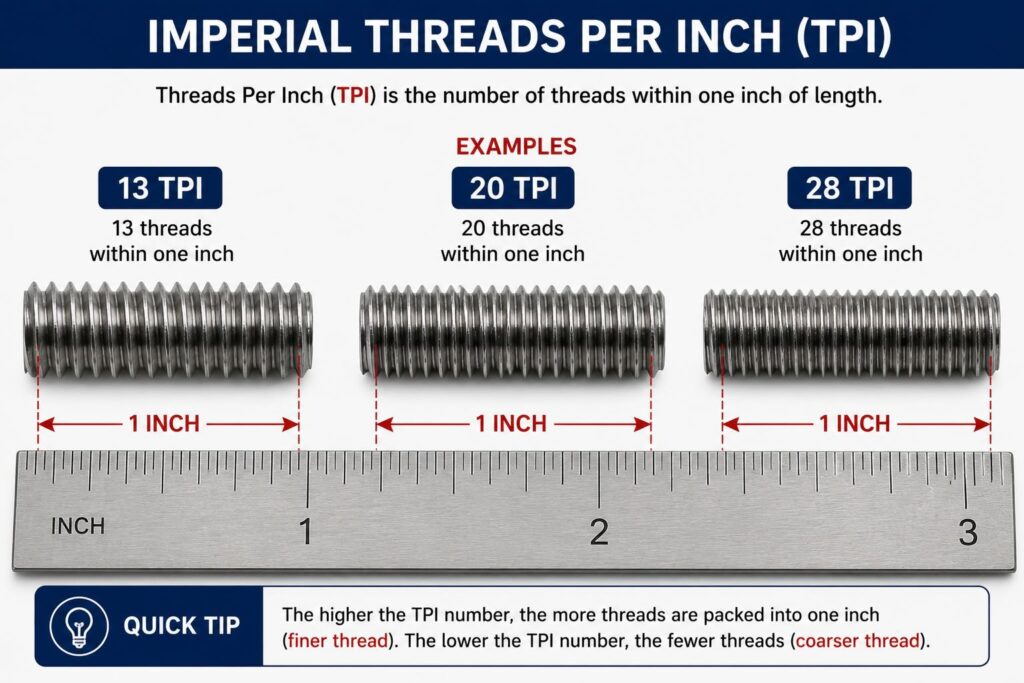
What Is Threads Per Inch (TPI)?
Threads Per Inch (TPI) is used on imperial (inch-based) fasteners. Instead of measuring the distance between threads, TPI counts how many threads are found within one inch.
Examples include:
Thread Size | TPI |
|---|---|
1/4”-20 UNC | 20 |
3/8”-16 UNC | 16 |
1/2”-13 UNC | 13 |
1/2”-20 UNF | 20 |
A higher TPI means more threads packed into one inch, resulting in finer threads.
Coarse vs Fine Threads
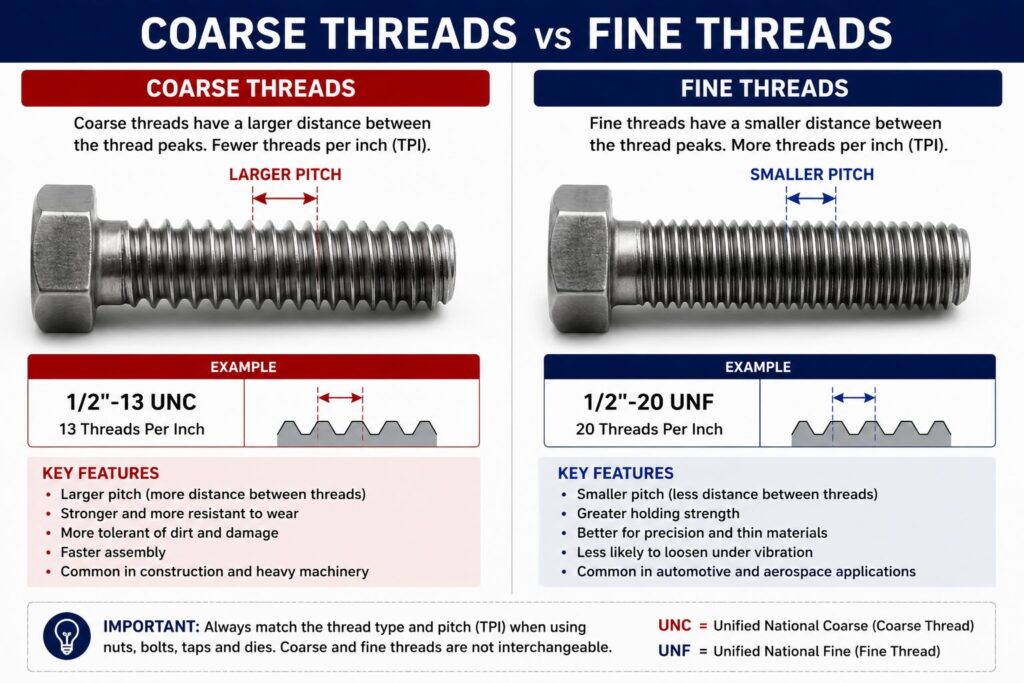
Thread pitch also determines whether a thread is coarse or fine.
Coarse Threads
- Larger thread spacing
- Faster assembly
- Better resistance to dirt and damage
- Common in construction and heavy machinery
Fine Threads
- Smaller thread spacing
- Greater holding strength
- Better for precision engineering
- Common in automotive and aerospace applications
Ace Hardware Zimbabwe Private Limited trades as Ace Industrial and is situated in Harare, Bulawayo and Mutare.
Quick Links
Harare
- 0777430174
- 0242754030
- quotes@acehardware.co.zw
- Harare: 35 Coventry Road, Cnr. Coventry Rd & Burnley Rd, Workington.
Mutare
- 0784555090
- 02064503
- acesales3@acehardware.co.zw
- Mutare: 10B Riverside Drive, P. O. Box 124
Bulawayo
- 0771348174
- 0963731
- byosales@acehardware.co.zw
- Bulawayo: 104 Fife Street, P. O. Box 943